DieselWin blackjack rules
Every game of online blackjack on the platform follows the core objective of beating the dealer’s hand without your total going over 21. You are not competing against the other seated players at a multi-seat table; your only target is the house hand. When you open a dieselwin live blackjack stream from Lucky Streak or Iconic21, or launch a digital table from Platipus, the round begins with the betting window. In live rooms, a timer gives you roughly fifteen seconds to place your chips on the felt. On digital RNG tables, there is no timer, so the cards only fly when you click the deal button.
Card values follow standard international rules across all variants in the lobby. Numbered cards from two through ten hold their face pip value. Picture cards—Jacks, Queens, and Kings—are all worth 10 points each. The Ace acts as the flexible card in the shoe, counting as either 1 or 11 depending on which value keeps your hand alive or builds a stronger total. A hand containing an Ace counted as 11 is called a soft hand, such as an Ace and a 6 making a soft 17. If you draw a 10 to that soft 17, the Ace automatically drops its value to 1, giving you a hard 17 instead of busting at 27. Suits have no ranking in standard twenty-one, though they can matter if you choose to place optional side wagers.
The payout structure is anchored by the 3:2 return for a natural blackjack. A natural occurs when your initial two cards total 21—specifically an Ace paired with any 10-value card. As an illustration of how the arithmetic works in GBP, suppose you place a £10 stake on the main betting spot and receive an Ace of Spades and a King of Hearts. Provided the dealer does not also hold a two-card 21, your £10 blackjack pays £15 in profit at 3:2, returning £25 in total to your balance. A standard winning hand, such as beating a dealer’s 18 with a three-card 20, pays even money at 1:1, where a £10 bet wins £10 in profit for a £20 total return. If your final total matches the dealer’s total, the result is a push, and your £10 stake comes straight back to you with nothing won or lost.
Dealer rules dictate how the house plays its cards after all players have finished acting. On the vast majority of multi-deck shoes in the live casino, the dealer must draw additional cards to any total of 16 or less and must stand on all 17s, including a soft 17. This rule is usually printed directly onto the virtual or physical felt in front of the chip tray. Because the dealer acts last, the house holds its mathematical edge: if your hand goes over 21 and busts, you lose your stake immediately, even if the dealer subsequently busts later in the same round. Checking whether a specific digital variant requires the dealer to hit or stand on soft 17 is always worth a quick glance at the table info screen.
Once you and the dealer have received two initial cards—both of yours face up, and one of the dealer’s face up alongside one face-down hole card or a single upcard under European dealing rules—you have several standard actions available on your screen:
- Hit and Stand: Clicking Hit requests another card from the shoe to increase your hand total. You can hit as many times as you like until you reach 21 or go bust. Clicking Stand locks in your current total and passes the action to the next seat or to the dealer.
- Double Down: Doubling allows you to double your initial stake in exchange for receiving one—and only one—additional card. If you bet £20 and receive an 11, choosing to double deducts another £20 from your balance, puts £40 on the felt, deals one final card to your hand, and automatically forces you to stand. Most tables allow doubling on any first two cards, while certain stricter digital variants restrict doubling to hard totals of 9, 10, or 11.
- Split Pairs: When your first two cards share the same numerical value, such as two 8s or a Queen and a Jack, the Split button lights up. Splitting separates the pair into two independent hands, placing an equal second bet from your balance onto the new hand. If you split a pair of 8s on a £15 bet, you now have two hands working at £15 each, for £30 total at risk. You then play out the first hand to completion before acting on the second. Splitting Aces almost always restricts you to receiving just one card on each Ace, and making 21 after a split counts as a regular 21 paying 1:1 rather than a natural 3:2 blackjack.
- Insurance and Even Money: Whenever the dealer’s exposed upcard is an Ace, the table offers an insurance wager before anyone draws a third card. Insurance costs exactly half of your original main stake and pays 2:1 if the dealer has a 10-value card underneath to complete a two-card blackjack. As an illustration, on a £10 main bet, insurance costs £5. If the dealer reveals a 10, your £10 main bet loses, while your £5 insurance bet wins £10 (returning £15), leaving you breakeven on the round. If the dealer does not have 21, the £5 insurance fee is swept away and the round continues. Statistically, taking insurance increases the house edge over time, so experienced players generally decline it.
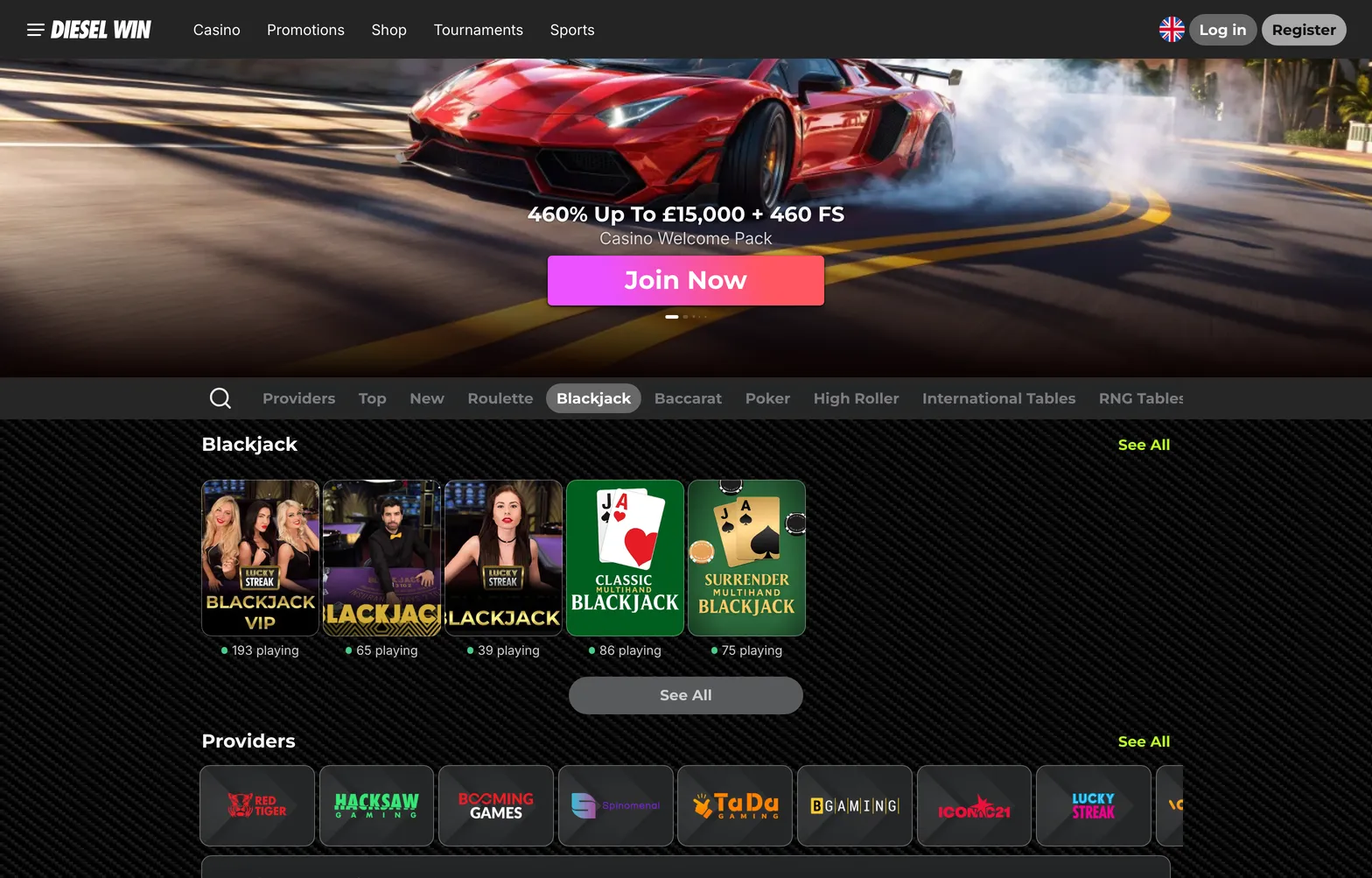
Live tables from Lucky Streak—including the prominent BlackjackVIP room featured on the main lobby—and Iconic21 bring extra features designed to handle busy hours when all seven main seats are occupied. The most useful of these is the Bet Behind function. When a table is full, or even while you are sitting in a seat yourself, you can place chips behind another active player’s box. When you bet behind, you share the outcome of that seated player’s decisions. In the settings menu for Bet Behind, you can pre-configure how your stake behaves if the seated player chooses to double down or split pairs; you can either set your software to automatically follow their double and split with your own funds or stay on a single stake.
Alongside Bet Behind, most dieselwin blackjack tables display small side-bet circles next to the main chip box. The two most common options to look for on the felt are Perfect Pairs and 21+3. Perfect Pairs settles purely on your first two cards, paying out if they form a mixed pair (different colours), a coloured pair (same colour, different suits), or a perfect pair (two identical cards from a multi-deck shoe, such as two Queens of Diamonds). The 21+3 side bet combines your first two cards with the dealer’s upcard to form a three-card poker hand, paying out for flushes, straights, three of a kind, and straight flushes. These side bets are completely optional, require a main hand bet to be active first, and carry a noticeably higher house edge than the main game.
Players who prefer a faster tempo without studio chatter often switch to the RNG tables in the Table Games tab. A standout title verified in the lobby is Single Deck Blackjack by Platipus. Unlike live shoes that shuffle six or eight decks together, a single-deck digital game deals from a virtual 52-card pack that reshuffles after every round. Single-deck rules alter the probabilities of catching 10-value cards when doubling down on 10 or 11.
For those who enjoy mixing card sessions with other markets on the site, the top navigation bar lets you move between the casino tables and the DieselWin sport bookmaker without shifting balances. Your GBP wallet stays unified across the entire account. If you are playing with an active welcome offer or reload bonus, remember that every £10 staked on dieselwin blackjack clears £1 (10%) off your wagering requirement, and terms can change, so glance at the promotion before you opt in.